Showing posts with label homosexuality. Show all posts

Thursday, November 12, 2015

Church Handbook 1: Revisons and Reactions


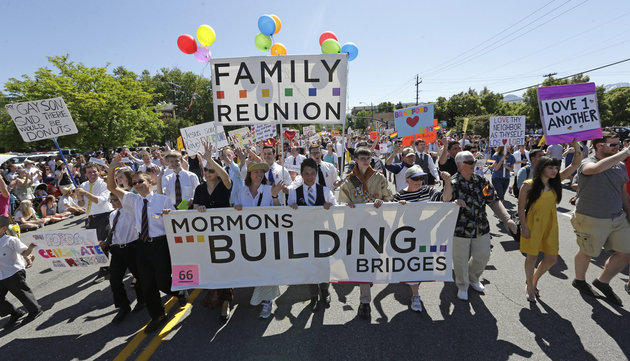
I am not one to say "I told you so", but I honestly believe these prancing parading advocates encouraging our loving embrace of openly homosexual behavior are the ones who have precipitated the recent Church action of revisions to Handbook 1 regarding same-sex behavior.

As it turns out, this group of marchers and those they presume to support WERE actually engaging in a sort of "bridge-building".  Just not the bridges they were anticipating.  They at least partially have themselves to blame for the changes in Church policy.  Life is full of such surprises.

I can also say that this clarification of Church policy regarding same-sex relationships and Church membership is an answer to my own fervent personal prayers.

It helps resolve my concern that the Law of Chastity was being revised for the benefit of a certain interest.  My understanding was always that everyone is required to live by the same set of rules, and no personal circumstance exists that would allow exceptions.


Though I am certain that there have been people praying for other solutions to this problem.  I know that there have been.  Their prayers have been answered too - just not the way they were expecting.


I understand that some are angry, hurt, disappointed and offended by the Church position.  But from my point of view, this was a change waiting to happen.  I can see that some advocates can make a case for their position with regard to certain aspects of these issues, but the arguments seem of little merit because their whole rationale begins with a false premise.  It is vain to protest that a rope is sound except for a fatal weakness at the top of the line.

As has been the case with so many other such actions from the Church, this implementation of new administrative policy was a response to current events.  And inspired Church leadership acting under Divine direction.

The developing situation had obviously left local leaders, the bishops and stake presidents, with an unfair burden on their judgement.  I can imagine being personally conflicted and torn by the many impassioned pleas for justice.  Especially in the face of such a shift in the legal scene.

Now that burden has been shifted.  I have little doubt that local leaders have made their own decisions about how to act in cases affected by this concern.  Perhaps some of them will be all the more troubled by this course of action.  But it was really the only way to resolve the conflict.

I am personally impressed that the policy change reflects the collective wisdom and experience of those who guide the Church with their prophetic calling.

And I am mightily relieved that I don't have to make such impactful decisions regarding people's lives.  In retrospect, I see that the drive to give legal status to same-sex marriage was the impetus for this seeming new policy.  In reality, there is nothing particularly new about it.  The policy simply extends administrative rules and oversight to Church doctrine that has long been in place. What is actually "new" is any hope or expectation that immoral behavior will be tolerated or accepted by the Church.  Indeed, the scope of acceptance and practice throughout the world shows a surprising degree of diversity, from countries that legally embraced same-sex relationships decades ago, to those who still cling to some vestiges of traditional morality.


Plenty of pubic sorrowing, agonized hand-wringing stories and demonstrations are now being staged.  As if advocates and those fully engaged in this behavior are shocked and surprised that anyone would ever think to disapprove of their choice to act in open defiance of eternal commandments, so presumptuously to spoil their blissfully happy homosexual relationships.  If you were among those so posturing, I'm honestly sorry to disappoint you, but rather pleased that you're not quite so in charge of things as you might have been led to believe.


All popular opinion to the contrary, it turns out that there really can be no such thing as "Mormons for Gay Marriage".  It is a total contradiction in terms.


My focus is not distracted.  As for me and my house, we will serve the Lord.  Not that I am claiming to be perfect in any particular aspect.  But striving nonetheless.

Saturday, February 07, 2015

Sexual politics in Utah just got real


In the Feb 06 2015 Salt Lake Tribune, Paul Mero submits a remarkable article correlating with the recent Church news conference.  It stands out in honesty and candor like few other related comments I have seen.  I have copied the entirety here because I think it merits serious reflection.  I think the Salt Lake Tribune does not seek to promote or provide balanced discussion in the public square, and is not a worthwhile venue to publish such an article.
In light of the local euphoria over the recent statements by The Church of Jesus Christ of Latter-day Saints regarding religious freedom and nondiscrimination, fully anticipating this euphoria to be temporary once the reality of what was actually said starts to sink in, I was reminded of the Hans Christian Andersen classic The Emperor's New Clothes.

You remember the story. Con men convince an arrogant and narcissistic king that they can make him a suit of clothes so special, so enlightened, that no mere common person would be able to see the suit. Of course, the king's sycophants weren't about to admit that they too were unable to see the clothing for fear of being marginalized as "hopelessly stupid." Once on public display, it took the innocence of a small child to reveal the obvious — the king "isn't wearing anything at all."
In its collective wisdom and painful honesty, the LDS Church, like the observant child in the classic story, just lifted all pretense from the serious debate over religious freedom and nondiscrimination. They said, for all intents and purposes, the emperor has no clothes. Sexual politics in Utah just got real.

With characteristic humility the LDS Church spokesmen told the truth: Resolving inherent legal conflicts between religious freedom and nondiscrimination will be very difficult. And I would add probably impossible to the liking of all opinions.
The legal conflict between religious freedom and nondiscrimination is inherent because those who cherish religious freedom view it much differently than those who cherish nondiscrimination and vice versa. Seasoned gay advocates know what I mean, as do seasoned defenders of religious freedom. Even as the LDS Church spokesmen uttered their words, seasoned observers knew that, far from drawing closer connections between the two issues, the divide had just grown wider.

The good news for sincere seekers of sound public policy is that the LDS Church's statements create an environment of honest dialogue. There is no more room for gay activists to imply LDS Church support for "activist sinners" (as opposed to repentant sinners) where none really exists. Nor is there room for social conservatives, like me, to imply that sexual politics can be simply ignored any longer.

The truth, now facing the Utah Legislature, is that nondiscrimination is forever linked with religious freedom in Utah. The delusion of Sens. Steve Urquhart and Jim Dabakis, that nondiscrimination is an absolute and independent civil right, has been laid to rest now by the LDS Church. More precisely, nondiscrimination is forever tied to the huge exception of individual conscience. In other words, there is no true religious freedom unless it applies equally to both religious institutions and their adherents.

Another delusion was settled, at least for the time being, by the statements of the LDS Church. Sexual politics is not viewed in the same pantheon of rights such as historic civil rights about race or sex. Despite sincere outreach to people with same-sex attraction issues, the LDS Church and most of Utah view homosexuality in terms of behavior. Race and sex (maleness and femaleness) are viewed as innate. For better or worse, homosexuality is largely viewed as something people do, not as something people are. This is precisely why the LDS Church cannot doctrinally satisfy gay activists who yearn to have their sexual relationships viewed as "worthy." And this is precisely why gay activists no doubt cringed when Elder Dallin H. Oaks punctuated during the Trib Talk interview that lifelong "chastity is not unique" to the human experience. His conclusion is unacceptable to gay activists — go ahead and "be gay" just don't engage in sexual relations outside of legal marriage defined as between a man and woman.

I appreciate this candor. It's refreshing even if it might make a prudent nondiscrimination bill more difficult to craft. Only one nondiscrimination bill with a clear provision for individual conscience can satisfy the constraints just imposed in principle by the LDS Church. Perhaps clever legislative attorneys can accomplish what LDS Church leaders, in the wisdom of Solomon, won't even attempt to address in the law. Good luck to all.

Paul Mero lives in Sandy, Utah, and can be reached at paulmero@msn.com.

I am uncertain about why Mr. Mero chose to publish this article in the Salt Lake Tribune.  It will certainly not be well received, or ever be thoughfully considered in that venue.  In fact it probably serves only to provoke more angry and threatening responses from the gentle readers of that journal.

Tuesday, July 18, 2006

Marriage amendment vote fails


Another attempt at considering an amendment to the US Constitution failed in the House vote.

The amendment, just like its predecessor, sought to define marriage as existing only between a man and a woman and was a priority for many family-values groups in and out of the Beltway.

This was the third vote in the American Values Agenda, which House Speaker Dennis Hastert (R-Ill.) introduced last month to minimal fanfare. After the amendment fell short yesterday, the Speaker criticized Democrats who opposed the measure and said a majority of Americans support the ban.

“Be assured that this issue is not over and that we will continue to send a message to the American people that preserving and protecting marriage is a priority,” Hastert said in a statement.

House Democrats condemned the marriage vote as a partisan political maneuver after the Senate rejected a similar amendment on a procedural vote last month that prevented leaders from bringing it to a vote.

A lot of the comments I see considering this issue seem to miss the real point. The underlying issue is a semantic question: What does “marriage” mean?

The Family Proclamation answers this, succinctly and unequivocally. I believe the official church interest in this matter is driven by prophetic inspiration, which forsees a developing crises involving of much greater scope than concerns about “alternative” fringe interests.

The final clause of the Proclamation is clearly politically directed, recognizing that legally defining marriage is rightfully a political issue, notwithstanding the sophistry of those who wish to simply disappear the problem by asserting that it is not.

LDS Church leaders urged public support from members in a letter sent to US Church units, to receive a mixed political reaction from supporters and detractors.


Some have suggested that from an LDS perspective, forcing others by law to live by correct principles is what Satan tried to impose. As I understand it, the proposal by Lucifer was that we would not have the option to exercise our own volition. He would dictate our actions. This arrangement would have had little in common with human government and laws which attempt to direct the choices we make under human agency. Under “Satan’s Plan”, there would be no choices.

We are instructed that all beings are endowed with fundamental insight into what constitutes the basis for morality. As moral beings it is our obligation to acknowledge that insight, and to attempt to codify it into a government structure and a legal system that reflect a positive disposition toward things which are “good” and a negative posture toward things which are “bad”. That our laws are an imperfect reflection of the ideal is axiomatic and acceptable, as long as our collective voice agrees that we are pointed in the right direction.


This is the real basis for the “definition of marriage” controversy. Now we experience discord in discussion of these issues because minority interests object to general rules which frame an advantage for others, but fail to address their specific minority concerns. Of course the ideal would be to implement laws which give no unfair preference to any single group, but there appears to be no way to serve that ideal perfectly. The acceptable compromise has long been that general rules which best serve the greatest number should prevail.

To propose to discard rules to which any minority finds marginal objection falls down the slippery slope toward anarchy.


The other day I listened to some ideas from a college student about the sanctity of room-mate relationships, as a strange parallel to the "gay marriage" rationale. It made me laugh. I have actually been campaigning to gain legal sanction for my loving relationship with my 1995 Toyota 4-Runner. For some reason, most refuse to take me seriously. ;-)

I agree that any focus on “gay” interests in considering this issue is off base, even to the point of being ridiculous. The attendent arguments are subterfuge to sidestep the most substantive question regarding the protection of the cultural definition of marriage, which affects vastly greater numbers than any “gay” actions ever will.

Perhaps it would be an acceptable (and infinitely more entertaining) solution, to designate a new government office regulating “gay” interests. Let us create an entire Federal bureaucracy exclusively for serving self-designated “gays”. It would prove once and for all that there aren’t really enough of them to warrant such a fuss.

Again, in my perception all of the discussion of peripheral issues effectively bypasses the vital point.

Perhaps it is more appealing for people to ignore the danger to real marriage, the issue that more directly concerns the vast majority, and instead focus on fringe, virtually inconsequential issues. Like whether “gays” are as good as normal people. Or whether polygamy should be legal.

In proper perspective, these are doubtless legitimate concerns, but should hardly rightfully occupy the top-of-the-list priority for the majority of us.

Very few will ever suffer any negative repercussions if the questions surrounding “gays” are never settled. This thread unravels into the surreal. As one who aspires to be a true disciple in the restored gospel, I try my best to understand direct statements from the First Presidency and to follow their counsel. Ideas forwarded by some in this discussion have thoroughly confused me. I cannot see how such thinking can possibly reconcile with the intent of the official statement.

In this context I can see how President Hinckley gets the impression that things might be as bad today as in the evil society of Sodom and Gommorah. While the Lord’s spokesman warns us that the traditional family is under heavy attack, some of us respond by hoping for more fully funded social welfare programs. The damage that accrues from problems with conventional marriages negatively impacts so many countless lives. As the problems multiply it becomes progressively more rare to find a “normal” family untroubled by problems with conventional marriage. Many of these problems are obviously inventions of our contemporary culture, and we could presumably discover effective means to correct them, if we only tried. Yet we are always distracted from the task by hand-wringing about “gays”.

I have wondered if just the open discussion of such trivia perhaps serves a bit of latent prurient interest.

(Speaking first for myself, of course. ;-)

Further discussion of BYU actions against "gay" protesters demonstrating on campus here and here.


I would observe that although it might be so inferred from certain comments on the internet, I would suppose that neither BYU nor the church has any independent civil authority to arrest protesters, or to so act in any other matters under the jurisdiction of civil laws. Offenders would be arrested by law enforcement officers, and answerable for legal violations directly to officers of the court, not BYU staff or officials.

Strangely, we also find homosexual apologists within the church actually looking to the Book of Mormon for proof-texts to represent the righteousness of accommodating homosexual activist demands. It makes little sense -- would we argue that because there is no Book of Mormon passage which explicitly forbids same-sex marriage, then it should be okay?

Indeed, as far as I know, there is no specific mention of proscriptions against homosexuality in the Book of Mormon, but there is explicit recognition of strict cultural observance of the Law of Moses. The Brass Plates apparently contained texts similar to our Old Testament, which offers condemnation for all kinds of sexual perversions in the most specific and unequivocal terms imaginable..

This Old Testament passage characterizes the law under which Book of Mormon society operated.

Thou shalt not lie with mankind, as with womankind: it is abomination.

Neither shalt thou lie with any beast to defile thyself therewith: neither shall any woman stand before a beast to lie down thereto: it is confusion.

Defile not ye yourselves in any of these things: for in all these the nations are defiled which I cast out before you:

And the land is defiled: therefore I do visit the iniquity thereof upon it, and the land itself vomiteth out her inhabitants. (Leviticus 18:22-25)

I strongly suspect no specifics were ever mentioned explicitly in the abridged histories of the Book of Mormon because the editors considered the topic of such abominations too disgusting and degrading to mention. Because they lived with and accepted this law, they already recognized how evil and awful the consequences of sexual immorality, therefore it needed no further elaboration.

Defenders of sexual deviance are ever wont to point out that such perversions have ancient historical roots and have existed in all societies from the beginning of time. This assertion, even if true, hardly constitutes a rational defense or justification for evil practices.