Showing posts with label LDS Church policy. Show all posts

Friday, October 14, 2016

Specific and Contemporary: LDS Church Counsel


The Church of Jesus Christ of Latter-day Saints has issued letters stating specific policy regarding support for two popular legislative measures from different areas in the US.

LDS Church leaders sent letters to members in Colorado expressing opposition to legalizing assisted suicide, as in Colorado Proposition 106.

Letters were also sent to Church members in California, Arizona, and Nevada encouraging them to oppose legislative measures which would legalize marijuana use.

"The church maintains a firm belief in the sanctity of human life," the First Presidency letter said, "and opposes deliberately taking the life of a person even when the person may be suffering from an incurable condition or disease. Life is a sacred gift and should be cherished even in difficult circumstances."

"While the church opposes physician-assisted suicide, members should not feel obligated to extend mortal life through means that are unreasonable. Decisions in such cases are best made by family members after receiving wise and competent medical advice and seeking divine guidance through fasting and prayer."

A growing number of scientific studies show that marijuana use disrupts brain development, according a review of the literature published by the American Psychological Association. Findings suggest structural and functional brain changes, and one decades-long longitudinal study showed an average loss of six IQ points among persistent users, similar to damage from exposure to lead.


Thursday, November 19, 2015

FairMormon Blog: Some Mistaken Claims


A nicely written article at FairMormon Blog discusses mistaken claims made by those critical about Handbook 1 revisions.


The author's conclusion...
It is understandable that good and faithful people may have questions about how this new policy will be administered. We encourage any with questions to study the scriptures, reflect  upon what apostles and prophets have to say on the matter,  ponder and pray, exercise patience, and look deeper than the slogans, memes, and sound-bites.
Throughout the so-called "Bloggernacle" are very few examples of discussion defending the Church of Church leaders.  The comments tend to be decidedly negative and critical.

Of all the blogs participating there, the FairMormon Blog is one of the best to follow.  I also am usually uplifted by posts at the Millenial Star blog.  Most of the others are simply not worth reading any more.  I occasionally waste my time searching for anything lovely, of good report, or praiseworthy.  I seldom find anything that qualifies any more.

It is interesting to note that Bloggernacle coverage of addresses given at the recent General Conference garnered little interest and few comments.  Few threads lasted much beyond the closing prayer.  By comparison, gripes about the Handbook 1 revisions have reverberated through the "Bloggernacle" unabated since the instant the administrative revisons were leaked for public criticism weeks ago.  In spite of the fact that administrative policy is not properly the concern of the general body of the Church, the continuing stress and criticism shows no sign of easing.

I am surprised every time to learn how faithless and fickle public opinion can be.

Monday, June 17, 2013

Divine Love


In the February 2003 Ensign, Elder Russel M. Nelson presents an exposition on "Divine Love".

In the article, Elder Nelson explains the nature of divine love, a frequently misunderstood and mistakenly characterized idea.  "While divine love can be called perfect, infinite, enduring, and universal, it cannot correctly be characterized as unconditional."

  He offers unambiguous scriptural references to conditional promises that the Lord has offered through time.   The nature of divine conditional love is expressed in specific language that characterizes such scriptures.
It is equally evident that certain blessings come from a loving Lord only if required conditions are met. Examples include:
If thou wilt walk in my ways, to keep my statutes and my commandments, … then I will lengthen thy days. (1 Kings 3:14)
If thou wilt walk in my statutes, and execute my judgments, and keep all my commandments … ; then will I perform my word with thee.” (1 Kings 6:12)
“I, the Lord, am bound when ye do what I say; but when ye do not what I say, ye have no promise.” (Doctrine and Covenants 82:10)
“When we obtain any blessing from God, it is by obedience to that law upon which it is predicated.” (Doctrine and Covenants 130:21)
“Unto every kingdom is given a law; and unto every law there are certain bounds also and conditions.” (Doctrine and Covenants 88:38)
Elder Nelson explains, "Understanding that divine love and blessings are not truly “unconditional” can defend us against common fallacies..."
“Since God’s love is unconditional, He will love me regardless …”; or 
“Since ‘God is love,’  He will love me unconditionally, regardless …”
These are popular ideas today, but they are as mistaken as the false teachings of Nehor in the Book of Mormon, 
...he also testified unto the people that all mankind should be saved at the last day, and that they need not fear nor tremble, but that they might lift up their heads and rejoice; for the Lord had created all men, and had also redeemed all men; and, in the end, all men should have eternal life. (Alma 1:4)
Does this mean that Jesus has no love for unbelievers and sinners?  No, it means that the Lord gives us our agency, and we choose the extent to which we receive the Lord's blessings.

Elder Nelson quotes from Brigham Young:
“Every blessing the Lord proffers to his people is on conditions. These conditions are: ‘Obey my law, keep my commandments, walk in my ordinances, observe my statutes, love mercy, … keep yourselves pure in the law, and then you are entitled to these blessings, and not until then.’” (Discourses of Brigham Young, sel. John A. Widtsoe (1954), 454)
Jesus asked us to love one another as He has loved us.  The pure love of Christ is granted to all who seek and qualify for it.   Such love requires our obedience to the conditions and laws upon which it is based.

Wednesday, October 03, 2012

Was it LDS Liberty that justified Plural Marriage?


More nonsense from LDS Liberty.  They recommend replacing the US Pledge of Allegiance with some pseudo-Religious propaganda instead.  The suggested "covenant" smacks of something that shouldn't be here at all.  I am ashamed to realize that such a poorly-considered idea comes from someone that I early on attempted to inculcate with the principles embodied in the Scout Oath.  I was apparently a poor teacher.  


I Pledge Allegiance to the Title of Liberty

Posted on June 29, 2012 by JC Bollers


We invite all who have entered the path toward eternal life to affirm their faithfulness to the covenant of liberty upon this land by pledging allegiance to the Title of Liberty that the blessings of liberty may rest upon our nation. We know that as we make only God our king take upon ourselves the name of Christ in all things both public and private and live his commandments in faith, that he will protect us, prosper us and number us among his covenant people. We proclaim that the understanding and performance of the very substance of this Title of Liberty will save this nation.
The following is an example of a covenant that we can make to affirm our allegiance to this standard:
“I covenant to sustain and establish the Title of Liberty and that I will not forsake God or be ashamed to take upon myself the name of Christ. And if I fall into transgression may the Lord rend me as I rend my garment.

 Then Connor goes on to explain why the Pledge is socialist propaganda, and he refuses to participate at all.

 Connor Boyack: Why I Do Not Pledge Allegiance to the Flag

Again this raises problems with the 12th Article of Faith and is inconsistent with established Church policy.

  We believe in being subject to kings, presidents, rulers, and magistrates, in obeying, honoring, and sustaining the law.

Reference to the 12th Article of Faith always brings up a specious question about Plural marriage, and the guys at LDS Liberty never miss that opportunity.


  • negates the 12th Article of Faith
  • Shiloh Logan The 8th Article of Faith actually vindicates and validates the 12th Article of Faith -- if you are honest and consistent to the message.
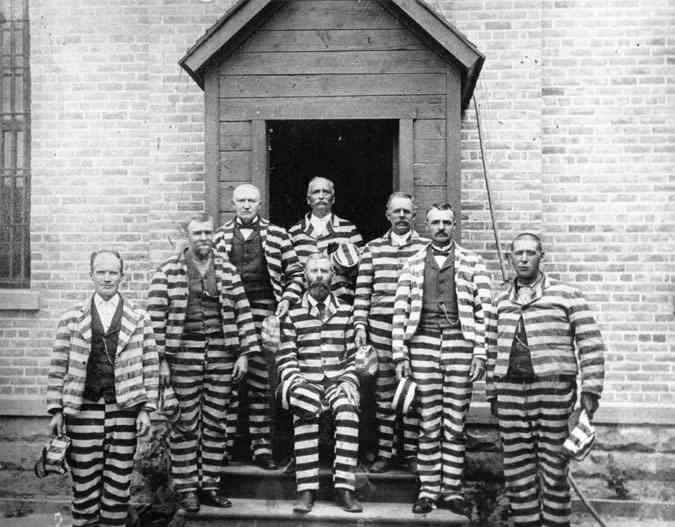
  • Charity Angel Do you know who is in this picture? Just curious because I know one of my ancestors was arrested and imprisoned for awhile for polygamy.
  • Spencer W. Morgan One of mine was too, in Idaho. I'll do some digging and see what I can find.
  • Spencer W. Morgan I found a few of the names:

    The photo caption reads:

    "Polygamists in striped prison uniforms, including George Q. Cannon (center with cane), William Gimbert Saunders (second from
    right), and William Morley Black (right of Cannon with white beard). These men were also known as "Prisoners of Conscience."


    Just for the record, the 8th Article of Faith is in no way related to political ideology:
     We believe the Bible to be the word of God as far as it is translated correctly; we also believe the Book of Mormon to be the word of God.

    Evidently, they derive something from the scripture that somehow justifies unlawful acts, as long as they feel good about it, or something like that.
    BTW, it is Wilford Woodruff that is featured in the center.
     It just so happens that I have a my own "Prisoner of Conscience" photo that features my own ancestor, Peter Barton, seated, in the center of the photo.  He served in the Utah State Senate for a term, and was the bishop of the Kaysville Ward for many years.  I don't think he is a particularly good poster child for the cause of rebellion.  He was the first polygamist to be pardoned by the Governor of Utah, for good behavior.  What is seldom considered is that the Lord instructed the church about the practice, when they were supposed to observe it, and when is was to cease.  The "Prisoners of Conscience" were all about obedience, not rebellion.  Too many overlook this point.


When it is the will of the Lord for church members to disobey the law of the land, the Lord will make it known through the Prophet, and none other.  This is not a principle of individualism, the noble one standing against Government oppression and tyranny.  It is the principle of obedience and sacrifice, of sacred covenants with God.  And to construe it as an example of rebellion and non-conformity for appearances is nothing more than mockery, of those faithful ones, and the Lord's laws.


Tuesday, October 02, 2012

Is this really LDS Liberty?


I'm engaged in a controversy with an internet group, calling themselves "LDS Liberty".  I think they are promulgating some false doctrine, and would prefer that they cease immediately.  Individual Church members are welcome to form their own opinions on any subject, whatever interests them.  But when they begin teaching their opinions as the "true" doctrine, I think it is time for some correction.

 Below is the correspondence I have thus far exchanged.  I will compile my complaints about their teaching and forward it to my bishop.

Friday, June 22, 2007

Creationism and Evolution


In my experience, the vast wastelands of the Internet are not a very helpful source of information on the Church, creation, and evolution.

Those of us just wanting to know what the issues are and what to think, tend to end up shell shocked by the intensity of participants in most of the discussion of relevant issues. While this is hardly an unusual environment for such a topic of controversy and debate, it does present a challenge for someone who prefers to be reasonably informed, reserve judgment, but just wants a bit more information.

Among of the best references I have found to actual Church doctrine and policy on this matter is at the biology department of BYU. Undergrad students at BYU use this information packet for reference. It contains a copy of several authoritative statements on the evolution and origins of man. You can read it without getting battered by proponents from any of the various warlike camps staked out all around this controversy.

One assertion I love to read very succinctly spells out what I want to know -- the real meaning of "evolution"...

Man is the child of God, formed in the divine image and endowed with divine attributes, and even as the infant son of an earthly father and mother is capable in due time of becoming a man, so the undeveloped offspring of celestial parentage is capable, by experience through ages and aeons, of evolving into a God.


From the information packet at BYU.


Highly recommended.

Friday, June 08, 2007

The Lord's Way


Dallin H. Oaks, The Lord's Way.

CHAPTER 4

CARE FOR THE POOR

In 1977 President Ezra Taft Benson explained the basic principles governing whether Latter-day Saints should accept government assistance: "Occasionally, we receive questions as to the propriety of Church members receiving government assistance instead of Church assistance. Let me restate what is a fundamental principle. Individuals, to the extent possible, should provide for their own needs. Where the individual is unable to care for himself, his family should assist. Where the family is not able to provide, the Church should render assistance, not the government. We accept the basic principle that 'though the people support the government, the government should not support the people.' "

He then voiced an important distinction between "earned" and "unearned" assistance, explaining its importance in terms of its spiritual impact on the recipient: "Latter-day Saints should not receive unearned welfare assistance from local or national agencies. This includes food stamps. Priesthood and Relief Society leaders should urge members to accept the Church welfare program and earn through the program that which they need, even though they may receive less food and money. By doing so, members will be spiritually strengthened, and they will maintain their dignity and self-respect."

By the 1980s, Latter-day Saints all over the world were being taxed to support a variety of government services not limited to the poor -- ­free hot lunches in grade schools, low tuition in colleges, and counseling services in between, to cite only a few examples. Should they forgo access to such generally available government programs ---­which they were taxed to support -- ­and turn only to the Church for aid?

As in President Benson's message quoted above, the Church has continued to counsel its members not to accept traditional government support of the poor, such as food stamps. But where a government-supported program is generally available to all citizens and where it can be squared with self-reliance and the other principles of church welfare, church leaders now raise no objection to their members' participation. For example, no objection is raised when a member makes a significant personal contribution in order to realize the benefits of a program (such as a student who must study in order to realize the benefit of the tax subsidy inherent in a low-tuition college education).

The principle of self-reliance and its relationship to government assistance is described in this key passage in the Leader's Guide to Welfare:

"Latter-day Saints have the responsibility to provide for themselves and their families. Individual members, however, may find it necessary to receive assistance beyond that which the family can provide, in which case they may turn to the Church for help. In some instances, individual members may decide to receive assistance from other sources, including government. In all such cases, members should avoid becoming dependent upon these sources and strive to become self-reliant. Where possible, they should work in return for assistance rendered."

In his testimony before the House Committee, Welfare Managing Director McMullin gave public expression to the new approach: "Where community resources are available that are compatible with our approach, we are happy to use them. Our overarching aim, however, is always to help people help themselves."

There is a large and perhaps widening gap between government's way and the Church's way of caring for the poor and the needy. The gap is inevitable because the Church's purposes, dictated by the commandments of God, are to serve spiritual as well as temporal goals.

Increasing urbanization and the diversities encountered in a worldwide church pose many challenges for those who are responsible to use the Lord's resources to help the poor and the needy. Recent changes in church organization and procedures facilitate this sacred mission, but the most important variables are still the attitude of the potential recipient and the inspired direction of the bishop. Neither of those fundamentals has changed. The Lord's way of welfare will continue unchanged, so long as the members are determined to support themselves to the best of their ability and then to participate in assisting others less fortunate, and so long as bishops continue to administer assistance in the Lord's way.

Monday, June 05, 2006

The deceivers who tangle the web...


Interesting SLTrib article today, from outspoken church critic RB Scott.


Mixing religion and politics: Oh, what a tangled web . . .

Ron starts off on the wrong foot with his blatantly inappropriate and offensive poetic title, and just naturally flows down hill from there.

He flatly -- and mistakenly -- insinuates that church leaders are practicing deceptive tactics in order to play a political game. Stirring up controversy, sowing the seeds of confusion and discord -- these are exactly the kind of reaction Ron always seems wont to provoke.

President Hinckley is not a liar by any definition. He needs no defense from people like Ron, who always manage to twist things to serve their own point of view.

I personally am certain that Ron will find, sometime in the future, that editorializing against the church carries a far greater cost than he can afford.

I have been following the reaction of various church members toward the First Presidency statement. It makes a fascinating study.

For the most part, in the general body of the church I think there is little controversy or question in our minds. When Church leaders counsel us to act, we act. Since we already support and sustain members of the first councils of the church as prophets, seers, and revelators, when they speak with authority, critical analysis can wait.

There are many, however, for whom some deliberation is apparently warranted. They demand to test inspired counsel against the philosophies of men, to satisfy their own intellect, or simply to show their own politically-correct approval or disapproval.

Whatever the reason, this small but vocal minority can always be noticed in such matters. They take the forefront in media coverage. They seem to love to "be seen of men". And, I believe, because they hear their own voices echoing in the silence, they presume to represent the rest of us.

I have no objection to others voicing their opinions, but I take exception when they presume to issue moral or intellectual judgments against the church or in opposition to Church authority. Those of us in the silent but faithful minority need to participate in the public forum, so as to avoid leaving the impression that dissenters and dissidents represent any significant segment of the faithful disciples. While it goes against my natural inclination to be outspoken, I have learned through sad experience that if we fail to protest when we are misrepresented, many of those who view things from without will assume that we have no opposing views and nothing to say in such matters. Apparently, from the legalistic perspective, it is true that "Silence gives assent".

In case any are mislead by the attempts so sow doubts about the legitimacy of religious groups engaging in political activism, at this link some of the guidelines are nicely illustrated.

It is a specious red-herring to insinuate that the tax-exempt status of the church is in jeopardy, or to suggest that the church would fail to take imperative action or unequivocally express an official position on issues with clear moral implications. This misinformation has often been perpetuated by the doubters and naysayers as justification for advocating non-involvement or avoidance of politically sensitive issues, but it is clearly contradicted by the facts. Those asserting that the church is putting tax-exempt status in jeopardy are apparently more interested in sowing the seeds of doubt than any loss of tax status.

When there is an issue upon which the voice of the Lord has been heard, the church will let it be known, in clear and unmistakable terms. Those with ears to hear, let them hear.