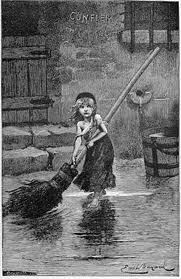
Showing posts with label Les Miserables. Show all posts

Friday, January 04, 2013

Les Miserables: Cosette and the Stranger


On the following morning, two hours at least before day-break, Thenardier, seated beside a candle in the public room of the tavern, pen in hand, was making out the bill for the traveller with the yellow coat.
His wife, standing beside him, and half bent over him, was following him with her eyes. They exchanged not a word. On the one hand, there was profound meditation, on the other, the religious admiration with which one watches the birth and development of a marvel of the human mind. A noise was audible in the house; it was the Lark sweeping the stairs.
After the lapse of a good quarter of an hour, and some erasures, Thenardier produced the following masterpiece:—
          BILL OF THE GENTLEMAN IN No. 1.

  Supper . . . . . . . . . . . . . . .     3 francs.
  Chamber  . . . . . . . . . . . . . .    10   "
  Candle . . . . . . . . . . . . . . .     5   "
  Fire . . . . . . . . . . . . . . . .     4   "
  Service  . . . . . . . . . . . . . .     1   "
                                          —————
                     Total . . . . . .    23 francs.
Service was written servisse.
"Twenty-three francs!" cried the woman, with an enthusiasm which was mingled with some hesitation.
Like all great artists, Thenardier was dissatisfied.
"Peuh!" he exclaimed.
It was the accent of Castlereagh auditing France's bill at the Congress of Vienna.
"Monsieur Thenardier, you are right; he certainly owes that," murmured the wife, who was thinking of the doll bestowed on Cosette in the presence of her daughters. "It is just, but it is too much. He will not pay it."
Thenardier laughed coldly, as usual, and said:—
"He will pay."
This laugh was the supreme assertion of certainty and authority. That which was asserted in this manner must needs be so. His wife did not insist.
She set about arranging the table; her husband paced the room. A moment later he added:—
"I owe full fifteen hundred francs!"
He went and seated himself in the chimney-corner, meditating, with his feet among the warm ashes.
"Ah! by the way," resumed his wife, "you don't forget that I'm going to turn Cosette out of doors to-day? The monster! She breaks my heart with that doll of hers! I'd rather marry Louis XVIII. than keep her another day in the house!"
Thenardier lighted his pipe, and replied between two puffs:—
"You will hand that bill to the man."
Then he went out.
Hardly had he left the room when the traveller entered.
Thenardier instantly reappeared behind him and remained motionless in the half-open door, visible only to his wife.
The yellow man carried his bundle and his cudgel in his hand.
"Up so early?" said Madame Thenardier; "is Monsieur leaving us already?"
As she spoke thus, she was twisting the bill about in her hands with an embarrassed air, and making creases in it with her nails. Her hard face presented a shade which was not habitual with it,—timidity and scruples.
To present such a bill to a man who had so completely the air "of a poor wretch" seemed difficult to her.
The traveller appeared to be preoccupied and absent-minded. He replied:—
"Yes, Madame, I am going."
"So Monsieur has no business in Montfermeil?"
"No, I was passing through. That is all. What do I owe you, Madame," he added.
The Thenardier silently handed him the folded bill.
The man unfolded the paper and glanced at it; but his thoughts were evidently elsewhere.
"Madame," he resumed, "is business good here in Montfermeil?"
"So so, Monsieur," replied the Thenardier, stupefied at not witnessing another sort of explosion.
She continued, in a dreary and lamentable tone:—
"Oh! Monsieur, times are so hard! and then, we have so few bourgeois in the neighborhood! All the people are poor, you see. If we had not, now and then, some rich and generous travellers like Monsieur, we should not get along at all. We have so many expenses. Just see, that child is costing us our very eyes."
"What child?"
"Why, the little one, you know! Cosette—the Lark, as she is called hereabouts!"
"Ah!" said the man.
She went on:—
"How stupid these peasants are with their nicknames! She has more the air of a bat than of a lark. You see, sir, we do not ask charity, and we cannot bestow it. We earn nothing and we have to pay out a great deal. The license, the imposts, the door and window tax, the hundredths! Monsieur is aware that the government demands a terrible deal of money. And then, I have my daughters. I have no need to bring up other people's children."
The man resumed, in that voice which he strove to render indifferent, and in which there lingered a tremor:—
"What if one were to rid you of her?"
"Who? Cosette?"
"Yes."
The landlady's red and violent face brightened up hideously.
"Ah! sir, my dear sir, take her, keep her, lead her off, carry her away, sugar her, stuff her with truffles, drink her, eat her, and the blessings of the good holy Virgin and of all the saints of paradise be upon you!"
"Agreed."
"Really! You will take her away?"
"I will take her away."
"Immediately?"
"Immediately. Call the child."
"Cosette!" screamed the Thenardier.
"In the meantime," pursued the man, "I will pay you what I owe you. How much is it?"
He cast a glance on the bill, and could not restrain a start of surprise:—
"Twenty-three francs!"
He looked at the landlady, and repeated:—
"Twenty-three francs?"
There was in the enunciation of these words, thus repeated, an accent between an exclamation and an interrogation point.
The Thenardier had had time to prepare herself for the shock. She replied, with assurance:—
"Good gracious, yes, sir, it is twenty-three francs."
The stranger laid five five-franc pieces on the table.
"Go and get the child," said he.
At that moment Thenardier advanced to the middle of the room, and said:—
"Monsieur owes twenty-six sous."
"Twenty-six sous!" exclaimed his wife.
"Twenty sous for the chamber," resumed Thenardier, coldly, "and six sous for his supper. As for the child, I must discuss that matter a little with the gentleman. Leave us, wife."
Madame Thenardier was dazzled as with the shock caused by unexpected lightning flashes of talent. She was conscious that a great actor was making his entrance on the stage, uttered not a word in reply, and left the room.
As soon as they were alone, Thenardier offered the traveller a chair. The traveller seated himself; Thenardier remained standing, and his face assumed a singular expression of good-fellowship and simplicity.
"Sir," said he, "what I have to say to you is this, that I adore that child."
The stranger gazed intently at him.
"What child?"
Thenardier continued:—
"How strange it is, one grows attached. What money is that? Take back your hundred-sou piece. I adore the child."
"Whom do you mean?" demanded the stranger.
"Eh! our little Cosette! Are you not intending to take her away from us? Well, I speak frankly; as true as you are an honest man, I will not consent to it. I shall miss that child. I saw her first when she was a tiny thing. It is true that she costs us money; it is true that she has her faults; it is true that we are not rich; it is true that I have paid out over four hundred francs for drugs for just one of her illnesses! But one must do something for the good God's sake. She has neither father nor mother. I have brought her up. I have bread enough for her and for myself. In truth, I think a great deal of that child. You understand, one conceives an affection for a person; I am a good sort of a beast, I am; I do not reason; I love that little girl; my wife is quick-tempèred, but she loves her also. You see, she is just the same as our own child. I want to keep her to babble about the house."
The stranger kept his eye intently fixed on Thenardier. The latter continued:—
"Excuse me, sir, but one does not give away one's child to a passer-by, like that. I am right, am I not? Still, I don't say—you are rich; you have the air of a very good man,—if it were for her happiness. But one must find out that. You understand: suppose that I were to let her go and to sacrifice myself, I should like to know what becomes of her; I should not wish to lose sight of her; I should like to know with whom she is living, so that I could go to see her from time to time; so that she may know that her good foster-father is alive, that he is watching over her. In short, there are things which are not possible. I do not even know your name. If you were to take her away, I should say: 'Well, and the Lark, what has become of her?' One must, at least, see some petty scrap of paper, some trifle in the way of a passport, you know!"
The stranger, still surveying him with that gaze which penetrates, as the saying goes, to the very depths of the conscience, replied in a grave, firm voice:—
"Monsieur Thenardier, one does not require a passport to travel five leagues from Paris. If I take Cosette away, I shall take her away, and that is the end of the matter. You will not know my name, you will not know my residence, you will not know where she is; and my intention is that she shall never set eyes on you again so long as she lives. I break the thread which binds her foot, and she departs. Does that suit you? Yes or no?"
Since geniuses, like demons, recognize the presence of a superior God by certain signs, Thenardier comprehended that he had to deal with a very strong person. It was like an intuition; he comprehended it with his clear and sagacious promptitude. While drinking with the carters, smoking, and singing coarse songs on the preceding evening, he had devoted the whole of the time to observing the stranger, watching him like a cat, and studying him like a mathematician. He had watched him, both on his own account, for the pleasure of the thing, and through instinct, and had spied upon him as though he had been paid for so doing. Not a movement, not a gesture, on the part of the man in the yellow great-coat had escaped him. Even before the stranger had so clearly manifested his interest in Cosette, Thenardier had divined his purpose. He had caught the old man's deep glances returning constantly to the child. Who was this man? Why this interest? Why this hideous costume, when he had so much money in his purse? Questions which he put to himself without being able to solve them, and which irritated him. He had pondered it all night long. He could not be Cosette's father. Was he her grandfather? Then why not make himself known at once? When one has a right, one asserts it. This man evidently had no right over Cosette. What was it, then? Thenardier lost himself in conjectures. He caught glimpses of everything, but he saw nothing. Be that as it may, on entering into conversation with the man, sure that there was some secret in the case, that the latter had some interest in remaining in the shadow, he felt himself strong; when he perceived from the stranger's clear and firm retort, that this mysterious personage was mysterious in so simple a way, he became conscious that he was weak. He had expected nothing of the sort. His conjectures were put to the rout. He rallied his ideas. He weighed everything in the space of a second. Thenardier was one of those men who take in a situation at a glance. He decided that the moment had arrived for proceeding straightforward, and quickly at that. He did as great leaders do at the decisive moment, which they know that they alone recognize; he abruptly unmasked his batteries.
"Sir," said he, "I am in need of fifteen hundred francs."
The stranger took from his side pocket an old pocketbook of black leather, opened it, drew out three bank-bills, which he laid on the table. Then he placed his large thumb on the notes and said to the inn-keeper:—
"Go and fetch Cosette."
While this was taking place, what had Cosette been doing?
On waking up, Cosette had run to get her shoe. In it she had found the gold piece. It was not a Napoleon; it was one of those perfectly new twenty-franc pieces of the Restoration, on whose effigy the little Prussian queue had replaced the laurel wreath. Cosette was dazzled. Her destiny began to intoxicate her. She did not know what a gold piece was; she had never seen one; she hid it quickly in her pocket, as though she had stolen it. Still, she felt that it really was hers; she guessed whence her gift had come, but the joy which she experienced was full of fear. She was happy; above all she was stupefied. Such magnificent and beautiful things did not appear real. The doll frightened her, the gold piece frightened her. She trembled vaguely in the presence of this magnificence. The stranger alone did not frighten her. On the contrary, he reassured her. Ever since the preceding evening, amid all her amazement, even in her sleep, she had been thinking in her little childish mind of that man who seemed to be so poor and so sad, and who was so rich and so kind. Everything had changed for her since she had met that good man in the forest. Cosette, less happy than the most insignificant swallow of heaven, had never known what it was to take refuge under a mother's shadow and under a wing. For the last five years, that is to say, as far back as her memory ran, the poor child had shivered and trembled. She had always been exposed completely naked to the sharp wind of adversity; now it seemed to her she was clothed. Formerly her soul had seemed cold, now it was warm. Cosette was no longer afraid of the Thenardier. She was no longer alone; there was some one there.
She hastily set about her regular morning duties. That louis, which she had about her, in the very apron pocket whence the fifteen-sou piece had fallen on the night before, distracted her thoughts. She dared not touch it, but she spent five minutes in gazing at it, with her tongue hanging out, if the truth must be told. As she swept the staircase, she paused, remained standing there motionless, forgetful of her broom and of the entire universe, occupied in gazing at that star which was blazing at the bottom of her pocket.
It was during one of these periods of contemplation that the Thenardier joined her. She had gone in search of Cosette at her husband's orders. What was quite unprecedented, she neither struck her nor said an insulting word to her.
"Cosette," she said, almost gently, "come immediately."
An instant later Cosette entered the public room.
The stranger took up the bundle which he had brought and untied it. This bundle contained a little woollen gown, an apron, a fustian bodice, a kerchief, a petticoat, woollen stockings, shoes—a complete outfit for a girl of seven years. All was black.
"My child," said the man, "take these, and go and dress yourself quickly."
Daylight was appearing when those of the inhabitants of Montfermeil who had begun to open their doors beheld a poorly clad old man leading a little girl dressed in mourning, and carrying a pink doll in her arms, pass along the road to Paris. They were going in the direction of Livry.
It was our man and Cosette.
No one knew the man; as Cosette was no longer in rags, many did not recognize her. Cosette was going away. With whom? She did not know. Whither? She knew not. All that she understood was that she was leaving the Thenardier tavern behind her. No one had thought of bidding her farewell, nor had she thought of taking leave of any one. She was leaving that hated and hating house.
Poor, gentle creature, whose heart had been repressed up to that hour!
Cosette walked along gravely, with her large eyes wide open, and gazing at the sky. She had put her louis in the pocket of her new apron. From time to time, she bent down and glanced at it; then she looked at the good man. She felt something as though she were beside the good God.


Saturday, December 29, 2012

Les Miserables: Fantine and M. Madeline

M. Madeleine had Fantine removed to that infirmary which he had established in his own house. He confided her to the sisters, who put her to bed. A burning fever had come on. She passed a part of the night in delirium and raving. At length, however, she fell asleep.
On the morrow, towards midday, Fantine awoke. She heard some one breathing close to her bed; she drew aside the curtain and saw M. Madeleine standing there and looking at something over her head. His gaze was full of pity, anguish, and supplication. She followed its direction, and saw that it was fixed on a crucifix which was nailed to the wall.
Thenceforth, M. Madeleine was transfigured in Fantine's eyes. He seemed to her to be clothed in light. He was absorbed in a sort of prayer. She gazed at him for a long time without daring to interrupt him. At last she said timidly:—
"What are you doing?"
M. Madeleine had been there for an hour. He had been waiting for Fantine to awake. He took her hand, felt of her pulse, and replied:—
"How do you feel?"
"Well, I have slept," she replied; "I think that I am better, It is nothing."
He answered, responding to the first question which she had put to him as though he had just heard it:—
"I was praying to the martyr there on high."
And he added in his own mind, "For the martyr here below."
M. Madeleine had passed the night and the morning in making inquiries. He knew all now. He knew Fantine's history in all its heart-rending details. He went on:—
"You have suffered much, poor mother. Oh! do not complain; you now have the dowry of the elect. It is thus that men are transformed into angels. It is not their fault they do not know how to go to work otherwise. You see this hell from which you have just emerged is the first form of heaven. It was necessary to begin there."
He sighed deeply. But she smiled on him with that sublime smile in which two teeth were lacking.
That same night, Javert wrote a letter. The next morning be posted it himself at the office of M. sur M. It was addressed to Paris, and the superscription ran: To Monsieur Chabouillet, Secretary of Monsieur le Prefet of Police. As the affair in the station-house had been bruited about, the post-mistress and some other persons who saw the letter before it was sent off, and who recognized Javert's handwriting on the cover, thought that he was sending in his resignation.
M. Madeleine made haste to write to the Thenardiers. Fantine owed them one hundred and twenty francs. He sent them three hundred francs, telling them to pay themselves from that sum, and to fetch the child instantly to M. sur M., where her sick mother required her presence.
This dazzled Thenardier. "The devil!" said the man to his wife; "don't let's allow the child to go. This lark is going to turn into a milch cow. I see through it. Some ninny has taken a fancy to the mother."
He replied with a very well drawn-up bill for five hundred and some odd francs. In this memorandum two indisputable items figured up over three hundred francs,—one for the doctor, the other for the apothecary who had attended and physicked Eponine and Azelma through two long illnesses. Cosette, as we have already said, had not been ill. It was only a question of a trifling substitution of names. At the foot of the memorandum Thenardier wrote, Received on account, three hundred francs.
M. Madeleine immediately sent three hundred francs more, and wrote, "Make haste to bring Cosette."
"Christi!" said Thenardier, "let's not give up the child."
In the meantime, Fantine did not recover. She still remained in the infirmary.
The sisters had at first only received and nursed "that woman" with repugnance. Those who have seen the bas-reliefs of Rheims will recall the inflation of the lower lip of the wise virgins as they survey the foolish virgins. The ancient scorn of the vestals for the ambubajae is one of the most profound instincts of feminine dignity; the sisters felt it with the double force contributed by religion. But in a few days Fantine disarmed them. She said all kinds of humble and gentle things, and the mother in her provoked tenderness. One day the sisters heard her say amid her fever: "I have been a sinner; but when I have my child beside me, it will be a sign that God has pardoned me. While I was leading a bad life, I should not have liked to have my Cosette with me; I could not have borne her sad, astonished eyes. It was for her sake that I did evil, and that is why God pardons me. I shall feel the benediction of the good God when Cosette is here. I shall gaze at her; it will do me good to see that innocent creature. She knows nothing at all. She is an angel, you see, my sisters. At that age the wings have not fallen off."


M. Madeleine went to see her twice a day, and each time she asked him:—
"Shall I see my Cosette soon?"
He answered:—
"To-morrow, perhaps. She may arrive at any moment. I am expecting her."
And the mother's pale face grew radiant.
"Oh!" she said, "how happy I am going to be!"
We have just said that she did not recover her health. On the contrary, her condition seemed to become more grave from week to week. That handful of snow applied to her bare skin between her shoulder-blades had brought about a sudden suppression of perspiration, as a consequence of which the malady which had been smouldering within her for many years was violently developed at last. At that time people were beginning to follow the fine Laennec's fine suggestions in the study and treatment of chest maladies. The doctor sounded Fantine's chest and shook his head.
M. Madeleine said to the doctor:—
"Well?"
"Has she not a child which she desires to see?" said the doctor.
"Yes."
"Well! Make haste and get it here!"
M. Madeleine shuddered.
Fantine inquired:—
"What did the doctor say?"
M. Madeleine forced himself to smile.
"He said that your child was to be brought speedily. That that would restore your health."
"Oh!" she rejoined, "he is right! But what do those Thenardiers mean by keeping my Cosette from me! Oh! she is coming. At last I behold happiness close beside me!"
In the meantime Thenardier did not "let go of the child," and gave a hundred insufficient reasons for it. Cosette was not quite well enough to take a journey in the winter. And then, there still remained some petty but pressing debts in the neighborhood, and they were collecting the bills for them, etc., etc.
"I shall send some one to fetch Cosette!" said Father Madeleine. "If necessary, I will go myself."
He wrote the following letter to Fantine's dictation, and made her sign it:—
 "MONSIEUR THENARDIER:—
          You will deliver Cosette to this person.
          You will be paid for all the little things.
          I have the honor to salute you with respect.
                                                  "FANTINE."
In the meantime a serious incident occurred. Carve as we will the mysterious block of which our life is made, the black vein of destiny constantly reappears in it.


Wednesday, December 26, 2012

Les Miserables: Fantine


Dark thoughts held possession of Fantine's heart

When she saw that she could no longer dress her hair, she began to hate every one about her. She had long shared the universal veneration for Father Madeleine; yet, by dint of repeating to herself that it was he who had discharged her, that he was the cause of her unhappiness, she came to hate him also, and most of all. When she passed the factory in working hours, when the workpeople were at the door, she affected to laugh and sing.

An old workwoman who once saw her laughing and singing in this fashion said, "There's a girl who will come to a bad end."

She took a lover, the first who offered, a man whom she did not love, out of bravado and with rage in her heart. He was a miserable scamp, a sort of mendicant musician, a lazy beggar, who beat her, and who abandoned her as she had taken him, in disgust.

She adored her child.

The lower she descended, the darker everything grew about her, the more radiant shone that little angel at the bottom of her heart. She said, "When I get rich, I will have my Cosette with me;" and she laughed. Her cough did not leave her, and she had sweats on her back.

One day she received from the Thenardiers a letter couched in the following terms: "Cosette is ill with a malady which is going the rounds of the neighborhood. A miliary fever, they call it. Expensive drugs are required. This is ruining us, and we can no longer pay for them. If you do not send us forty francs before the week is out, the little one will be dead."

She burst out laughing, and said to her old neighbor: "Ah! they are good! Forty francs! the idea! That makes two napoleons! Where do they think I am to get them? These peasants are stupid, truly."

Nevertheless she went to a dormer window in the staircase and read the letter once more. Then she descended the stairs and emerged, running and leaping and still laughing.

Some one met her and said to her, "What makes you so gay?"

She replied: "A fine piece of stupidity that some country people have written to me. They demand forty francs of me. So much for you, you peasants!"

As she crossed the square, she saw a great many people collected around a carriage of eccentric shape, upon the top of which stood a man dressed in red, who was holding forth. He was a quack dentist on his rounds, who was offering to the public full sets of teeth, opiates, powders and elixirs.

Fantine mingled in the group, and began to laugh with the rest at the harangue, which contained slang for the populace and jargon for respectable people. The tooth-puller espied the lovely, laughing girl, and suddenly exclaimed: "You have beautiful teeth, you girl there, who are laughing; if you want to sell me your palettes, I will give you a gold napoleon apiece for them."

"What are my palettes?" asked Fantine.

"The palettes," replied the dental professor, "are the front teeth, the two upper ones."

"How horrible!" exclaimed Fantine.

"Two napoleons!" grumbled a toothless old woman who was present. "Here's a lucky girl!"

Fantine fled and stopped her ears that she might not hear the hoarse voice of the man shouting to her: "Reflect, my beauty! two napoleons; they may prove of service. If your heart bids you, come this evening to the inn of the Tillac d'Argent; you will find me there."

Fantine returned home. She was furious, and related the occurrence to her good neighbor Marguerite: "Can you understand such a thing? Is he not an abominable man? How can they allow such people to go about the country! Pull out my two front teeth! Why, I should be horrible! My hair will grow again, but my teeth! Ah! what a monster of a man! I should prefer to throw myself head first on the pavement from the fifth story! He told me that he should be at the Tillac d'Argent this evening."

"And what did he offer?" asked Marguerite.

"Two napoleons."

"That makes forty francs."

"Yes," said Fantine; "that makes forty francs."

She remained thoughtful, and began her work. At the expiration of a quarter of an hour she left her sewing and went to read the Thenardiers' letter once more on the staircase.

On her return, she said to Marguerite, who was at work beside her:—

"What is a miliary fever? Do you know?"

"Yes," answered the old spinster; "it is a disease."

"Does it require many drugs?"

"Oh! terrible drugs."

"How does one get it?"

"It is a malady that one gets without knowing how."

"Then it attacks children?"

"Children in particular."

"Do people die of it?"

"They may," said Marguerite.

Fantine left the room and went to read her letter once more on the staircase.
That evening she went out, and was seen to turn her steps in the direction of the Rue de Paris, where the inns are situated.

The next morning, when Marguerite entered Fantine's room before daylight,—for they always worked together, and in this manner used only one candle for the two,—she found Fantine seated on her bed, pale and frozen. She had not lain down. Her cap had fallen on her knees. Her candle had burned all night, and was almost entirely consumed. Marguerite halted on the threshold, petrified at this tremendous wastefulness, and exclaimed:—

"Lord! the candle is all burned out! Something has happened."

Then she looked at Fantine, who turned toward her her head bereft of its hair.

Fantine had grown ten years older since the preceding night.

"Jesus!" said Marguerite, "what is the matter with you, Fantine?"

"Nothing," replied Fantine. "Quite the contrary. My child will not die of that frightful malady, for lack of succor. I am content."

So saying, she pointed out to the spinster two napoleons which were glittering on the table.

"Ah! Jesus God!" cried Marguerite. "Why, it is a fortune! Where did you get those louis d'or?"

"I got them," replied Fantine.

At the same time she smiled. The candle illuminated her countenance. It was a bloody smile. A reddish saliva soiled the corners of her lips, and she had a black hole in her mouth.

The two teeth had been extracted.

She sent the forty francs to Montfermeil.

After all it was a ruse of the Thenardiers to obtain money. Cosette was not ill.

Fantine threw her mirror out of the window. She had long since quitted her cell on the second floor for an attic with only a latch to fasten it, next the roof; one of those attics whose extremity forms an angle with the floor, and knocks you on the head every instant. The poor occupant can reach the end of his chamber as he can the end of his destiny, only by bending over more and more.

She had no longer a bed; a rag which she called her coverlet, a mattress on the floor, and a seatless chair still remained. A little rosebush which she had, had dried up, forgotten, in one corner. In the other corner was a butter-pot to hold water, which froze in winter, and in which the various levels of the water remained long marked by these circles of ice. She had lost her shame; she lost her coquetry. A final sign. She went out, with dirty caps. Whether from lack of time or from indifference, she no longer mended her linen. As the heels wore out, she dragged her stockings down into her shoes. This was evident from the perpendicular wrinkles. She patched her bodice, which was old and worn out, with scraps of calico which tore at the slightest movement. The people to whom she was indebted made "scenes" and gave her no peace. She found them in the street, she found them again on her staircase. She passed many a night weeping and thinking. Her eyes were very bright, and she felt a steady pain in her shoulder towards the top of the left shoulder-blade. She coughed a great deal. She deeply hated Father Madeleine, but made no complaint. She sewed seventeen hours a day; but a contractor for the work of prisons, who made the prisoners work at a discount, suddenly made prices fall, which reduced the daily earnings of working-women to nine sous. Seventeen hours of toil, and nine sous a day! Her creditors were more pitiless than ever. The second-hand dealer, who had taken back nearly all his furniture, said to her incessantly, "When will you pay me, you hussy?" What did they want of her, good God! She felt that she was being hunted, and something of the wild beast developed in her. About the same time, Thenardier wrote to her that he had waited with decidedly too much amiability and that he must have a hundred francs at once; otherwise he would turn little Cosette out of doors, convalescent as she was from her heavy illness, into the cold and the streets, and that she might do what she liked with herself, and die if she chose.

"A hundred francs," thought Fantine. "But in what trade can one earn a hundred sous a day?"

"Come!" said she, "let us sell what is left."

The unfortunate girl became a woman of the town.

Sunday, February 24, 2008

You no longer belong to evil, but to good...

Vignette of a scene from Les Miserables.

As the brother and sister were about to rise from the table, there came a knock at the door.

"Come in," said the Bishop.

The door opened. A singular and violent group made its appearance on the threshold. Three men were holding a fourth man by the collar. The three men were gendarmes; the other was Jean Valjean.

A brigadier of gendarmes, who seemed to be in command of the group, was standing near the door. He entered and advanced to the Bishop, making a military salute.

"Monseigneur--" said he.

At this word, Jean Valjean, who was dejected and seemed overwhelmed, raised his head with an air of stupefaction.

"Monseigneur!" he murmured. "So he is not the cure?"

"Silence!" said the gendarme. "He is Monseigneur the Bishop."

In the meantime, Monseigneur Bienvenu had advanced as quickly as his great age permitted.

"Ah! here you are!" he exclaimed, looking at Jean Valjean. "I am glad to see you. Well, but how is this? I gave you the candlesticks too, which are of silver like the rest, and for which you can certainly get two hundred francs. Why did you not carry them away with your forks and spoons?"

Jean Valjean opened his eyes wide, and stared at the venerable Bishop with an expression which no human tongue can render any account of.

"Monseigneur," said the brigadier of gendarmes, "so what this man said is true, then? We came across him. He was walking like a man who is running away. We stopped him to look into the matter. He had this silver--"

"And he told you," interposed the Bishop with a smile, "that it had been given to him by a kind old fellow of a priest with whom he had passed the night? I see how the matter stands. And you have brought him back here? It is a mistake."

"In that case," replied the brigadier, "we can let him go?"

"Certainly," replied the Bishop.

The gendarmes released Jean Valjean, who recoiled.

"Is it true that I am to be released?" he said, in an almost inarticulate voice, and as though he were talking in his sleep.

"Yes, thou art released; dost thou not understand?" said one of the gendarmes.

"My friend," resumed the Bishop, "before you go, here are your candlesticks. Take them."

He stepped to the chimney-piece, took the two silver candlesticks, and brought them to Jean Valjean. The two women looked on without uttering a word, without a gesture, without a look which could disconcert the Bishop.

Jean Valjean was trembling in every limb. He took the two candlesticks mechanically, and with a bewildered air.

"Now," said the Bishop, "go in peace. By the way, when you return, my friend, it is not necessary to pass through the garden. You can always enter and depart through the street door. It is never fastened with anything but a latch, either by day or by night."

Then, turning to the gendarmes:--

"You may retire, gentlemen."

The gendarmes retired.

Jean Valjean was like a man on the point of fainting.

The Bishop drew near to him, and said in a low voice:--

"Do not forget, never forget, that you have promised to use this money in becoming an honest man."

Jean Valjean, who had no recollection of ever having promised anything, remained speechless. The Bishop had emphasized the words when he uttered them. He resumed with solemnity:--

"Jean Valjean, my brother, you no longer belong to evil, but to good. It is your soul that I buy from you; I withdraw it from black thoughts and the spirit of perdition, and I give it to God."