Showing posts with label angiogram. Show all posts

Friday, June 21, 2013

Coronary Artery Bypass Grafting

CABG procedure in progress

CABG is a medical acronym that stands for Coronary Artery Bypass Grafting

I have been reviewing my blog posts, and realized that there is a big hole in my blog entries, starting about October 2011 and going forward for about a year.  Sorta like the big hole in my chest that appeared just about that time.

One of the excuses I offer for my lapse is that I had a timeout for a heart attack and bypass surgery.  In medical parlance, they refer to it as "myocardial infarction".  To me it was just plain ol hurtin.

I had the acute heart attack episode in September 2011.  I came home from work that day feeling rather tired, so I tried to lay down and take a nap.  But I had a persistent sharp chest pain, and was having difficulty breathing while laying down.  I had little inkling of just what was developing inside my body, but since laying down proved too uncomfortable, I went to the family room to sit in the big cushy recliner and watch TV.

I live with my mom, but she had been gone on an extended shopping trip since that morning, so I was home alone.  I got more uncomfortable as time went on, but still had no suspicion that I was experiencing a heart attack.


Finally my mom came home late in the afternoon.  She had been experiencing frustrations of her own, with shopping crowds, road construction, her car running out of gas, preparing a meal for a Relief Society assignment for some families in the ward, and a host of other annoyances and inconveniences.   She started telling all about it, while she put Papa Murphy's pizzas into the oven.  She had been planning to fix casserole for the other families, but ran short of time and decided to do quick Take 'N' Bake pizzas instead.


I sat on the couch, immersed in a haze of pain, not paying much attention to her recounting of the challenges of her day.  When the first batch of pizzas were cooked, she left to deliver them, after putting in some to bake for us.

By the time she returned, the pain had increased to an alarming level, though during earlier episodes with health problems I have endured much higher pain levels.   I just didn't understand what was happening.

We sat down together to eat pepperoni pizza, and I was thinking I might feel a little better after I ate something.  So I had a couple of slices of pizza.

After we had dinner, I returned to the recliner.  Eating dinner didn't help.  I got to hurting so bad, I felt like I just wanted to go off to bed, and sleep it off.  But I got in some kind of surreal argument with my mom as I attempted to head off, and finally confessed to her just how awful I was feeling.  She wouldn't let me just go to bed, but insisted that I needed some emergency medical attention, and it turns out she was right.

Dammit, she's ALWAYS right!  Why do I even bother to argue?

Anyway I donned my footwear and she drove me to the hospital emergency room at Utah Valley Regional Medical Center.  I was unhappy to be heading there for yet another hospital adventure, but it hurt me so bad, I didn't argue.

Checking in at the ER

When we arrived, the ER attendant quickly wheeled me in to an exam room, and the doctors and nurses began their probing and prodding and inquisition.  One hitch that I encounter with every doctor visit these days is how I should answer their question about pain.
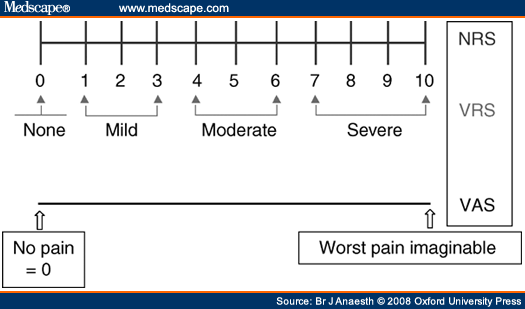
Numeric Pain Rating Scale

Medical people all ask the same question to evaluate patients experiencing pain.  "On a scale of 1 to 10, how would you rate your pain level, with zero being no pain, and ten being the worst pain imaginable."

Okay, that's clear enough to understand.  My problem is, how to frame my response, because I have in the past experienced a nightmarish raving screaming in pain, such intolerable pain that I was more than willing to die right then to have it stop, bouts of pain that would rise to a crescendo, until finally it would cause me to pass out.  So I can imagine quite a lot.  My past experience kinda tends to make the pain rating scale irrelevant.

The compromise I have arrived at for such situations, which have been all too frequent lately, is generally to report a pain rating level of 7.  I know from experience that this is the level medical professionals consider to justify some kind of medication as intervention for pain relief.

They finally gave me a big shot of morphine, and immediately I was breathing much easier.  Pain drugs are so wonderful!

As they worked on me in the ER, my mom had phoned my sister Cindy, and she came right away with her husband Carl to the hospital.  That was another routine that had become far too routine, but Carl and his son administered a priesthood blessing, which is always a comfort to me in times of distress.

Quite some time passed.  Then the ER doctor made an extended presentation of what they knew so far.  He explained that test results were somewhat ambiguous, indications from blood testing were that I'd had a significant myocardial infarction, but the chest x-rays also indicated some pericarditus.


During a heart attack, heart muscle cells die and release certain proteins into the bloodstream.  The blood tests showed this, but there were other possible explanations for my symptoms.

After some medical deliberation, the doctors brought in the heart specialist.  He recommended that they perform a coronary angiogram, which helps them map blood circulation to the heart,  and allows them to perform angioplasty, and to emplace a coronary stent where they judge it is warranted, to help open blocked arteries.

Soon they wheeled me into the pre-op room, where they prepared me for the catheterization lab.  The guy that was prepping me injected me with something, and I don't remember anything after that for what seemed like a long blackness.

I don't know exactly what they saw in the cath lab, but next thing I knew, I was back in pre-op being prepped for the CABG operation.

Those moments are pretty fuzzy to recollect.  I heard people saying things around me, but they seemed to be very far away, and it was much too difficult to respond.  What I remember mostly is people offering reassurance and encouragement, but I wasn't sure why.  I still didn't realize what was happening.

After that I remember going into the operating room, transferring from the gurney onto a narrow table, laying on my back.  All kinds of people bustling around in surgical gowns with gloves.  Then someone put a mask on my face, and told me to start taking some deep breaths.  That's the last awareness I had for what seemed like a long time.

Apparently, while I was unconscious, the doctors had decided that the angiogram results indicated that there were too many severe arterial blocks to correct with angioplasty and stents.  Facing the possibility of my immanent demise, my mom gave the go-ahead for the doctors to perform the CABG surgery.  The cardiac surgeon apparently told my mom it was lucky for me that she brought me into the ER, instead of letting me just go to bed as I had wanted, because I would not have survived the night with the current condition of my heart.

Heart during CABG procedure
The surgery involved cutting a long incision down the center of my chest.  Apparently then they saw apart the ribs, and use an instrument called a rib-spreader to force apart the rib cage and expose the chest cavity and the still-active heart.

The surgical team

The CABG procedure apparently employs quite a team of doctors and nurses gathered around the exposed heart.  Before they put me under the anesthetic, I noticed a pretty big crowd of people were in the OR.  Everyone is wearing a surgical mask, so even if I knew anyone, I would probably not have recognized them.  I guess some of them mighta just been curious spectators, or even space aliens just dropping in for a visit from another planet, I honestly dunno.

Heart-lung machine

To get the CABG started, the heart is prepared for attachment of the cardio-pulmonary bypass machine, which during the surgical bypass procedure, replaces the normal functioning of the patient's heart and lungs, hopefully temporarily.  Plastic tubes carry blood from the heart to the machine and back.  While passing through the machine, transported by mechanical pump, the blood is oxygenated and returned to the body.

At this point the surgeon administers a cardioplegic agent, which paralyzes the heart muscle and stops the heart from beating, just as in death.   The patient is effectively being kept alive by temporary artificial cardiovascular perfusion.

Prior to the opening of the chest cavity, another team is involved in harvesting veins from the leg or arm to use to bypass blocked coronary arteries.  In my case, the blood vessels to be used in bypass grafts were extracted from my right leg, typically using the "great saphenous vein".  Apparently they utilized some type of endoscopic technique - I'm not certain, but there is no incision scar on my leg.


During the procedure, the cardiac surgeon performed seven bypass grafts on my heart.  That seems like an unusually high number to me - I've heard of double, triple, quadruple bypasses before, but I never heard of seven.  I guess they had plenty of grafting material, so why not go for it?   Maybe I'm just lucky to still be alive.  They don't even seem to have a term in medical jargon for a seven-artery bypass.

So the surgery took about 8 hours of the surgical team working on me.   Obviously they went to a great deal of trouble in my behalf.  My heart was not beating for much of that time, which is difficult for me to imagine.  Perhaps it is fortunate for me that I don't remember any part of it.  But in any case, they performed the CABG, got my heart beating once again, and closed up that huge gaping incision in my chest.

Shocking the heart to stimulate heartbeat
Next thing I knew, I was waking up some time in the afternoon of the following day, in the  cardiac intensive care unit at the hospital, there was a big incision wound sutured down my chest, wires and tubes trailing out of it, with attachments to all manner of devices that I could not really see.  I could hear them, though - beeping and ringing and vacuuming me right on cue, as if to reassure the attendants that I was still alive.

Actually the first shock to me was to realize that I WAS STILL ALIVE!  I think I had prepared myself for dying, but being kept alive hooked to a bunch of machines, seemed like much more than I was ready to accept.

I recall very little about the first few days.  One memory of the attendant assisting me to sit up in the bed.  With help, I swung my legs out of the bed, and just about the time my feet were touching the floor, everything suddenly went black again.  I heard someone saying something like, "He's passing out!", and don't remember what happened after that.  I guess I woke up a bit later.

I was several days in the cardiac intensive care, then they moved me to a bigger room somewhere else in the hospital, I don't really know where.  During that period, I got physical therapy from a whole cadre of people, I don't remember much about.  They encouraged me to stand up, and eventually to walk around the ward, it you could call it walking.  I was also coached about breathing exercises by the cardiologist and a host of others I don't remember too well.

They seemed to have a lot of interest in my capacity for continued breathing.
Apparently that is one factor they encounter lots of complications with in cardiac care.  They gave me a little plastic gadget for measuring my breathing capacity, and I was supposed to exercise with it regularly.  I did the breathing exercises, but I could never tell that it made all that much difference.


A number of people visited while I was there, many of whom I don't recall.  Several notable visits including Dr. Kennedy, my family doctor.   Two ladies from Ability First, where I had been working.  My cousin Randy.  People from my ward.  Several of my sisters.  And of course, my mom.

One of the grossest things in all of this nightmare experience - at least, that I was conscious for - was when I was getting ready to check out from UVRMC.  The whole time I was there, I had a number of "things" attached to me, among other pleasantries, several big plastic tubes trailing out of my chest leading off to some kind of suction pumps.  I guess the object was to remove any excess blood that accumulated in my body's various cavities as a result of the surgical wounds.


When the time came, they just yanked them out, rather unceremoniously, from my perspective.  It was quite horrifying to me, watching these big plastic tubes come slithering out of my body.  I was afraid I would come apart at the seams or something, and all my guts come spilling out across the bed.  Over the next few months I had the uneasy feeling that if I sneezed too hard, or happened to be too roughly jostled, my chest would open up and everything would gush out on the floor.  To make it worse, medical authorities routinely warn those who have had their chest surgically opened to be careful about heavy lifting and reaching overhead. 


Of course the biggest relief of all was having that damned Foley catheter removed.  It never is comfortable to have that thing jammed up one of the most sensitive parts of the body.  I was not capable of urinating by myself for a while, so I guess it was necessary.  But what tortuous hospital appliance could be more undignified, I cannot imagine. 

So after my time in the hospital, they got tired of me, and sent me across the street to a rehab place.   They delivered me in an ambulance, to ride across the street.  How exciting.   I was at the rehab and nursing care center for several fairly uneventful months before they finally sent me home.

Several other issues related to the CABG procedure have come to my attention since I had the surgery.  I believe they are of general interest to anyone involved in such an operation.


My older brother had an artificial heart valve implanted in a similar procedure, and he expressed concern about one of the side-effects popularly referred to as "pump-head", or in medical parlance, postperfusion syndrome.  The syndrome is rather controversial, and is provisionally characterized by a wide array of neurological deficits that are manifested following surgery that involves perfusion.  Medical authorities theorize the syndrome may be caused by tiny debris and air bubbles (microemboli) that enter the brain via the action of the heart-lung bypass machine.  Scientific research has returned contradictory findings.

Am I any more stupid than I was before the surgery?  I don't really know.  There is no objective method for me to assess my own cognitive functions, other than those that use those very functions.  I have no way to distinguish between neurological defits resulting from my strokes and other medical issues and the CABG surgery.   It becomes a sort of recursive question, one that seems to be of much particular interest to no one but myself.
Another standing question from the CABG procedure relates to how the surgery affects people, particularly in ways other than the most obvious.  A number of scientific studies indicate that postop outcomes directly affect many quality-of-life issues.


One of the relative measures of success for post-CABG is referred to as "graft patency".  It expresses coronary circulation in grafted veins, as a percentage of optimum.  CABG veins go through the same occlusion processes that the original arteries are subject to, and the general projection estimates an average of five years of life from the grafted veins.  Then it is expected that CABG recipients who have survived that long will undergo another CABG procedure to replace the old grafts.


In further medical episodes that have been staged in more recent times, I have experienced chest pains and breathing difficulty, with lots of rather disturbing irregular heartbeats.  There have been doctor visits to all kinds of specialists, and not a few trips to the ER.

Most recently I consulted with a cardiologist, and though the outcome of the session was as unsatisfying to me as most other doctor visits, among other things he recommended that I have a cardiac stress test.


He prescribed for me to start taking a very commonly used diuretic, Lasix or generic furosemide, even though I protested that I had tried diuretics before, and the side-effects for me were intolerable.  The good doctor seemed not to hear me.  After trying the drug for one day, and spending most of the subsequent night in the bathroom, I decline to take any more of the stuff.

The cardiologist had also prescribed an additional drug which I never obtained, since the pharmacist informed me, when I requested the prescription, medical insurance would not cover the cost of that drug, therefore decided I really didn't need the drug that the doctor had prescribed all that much.  Another instance of health insurance informing my need for health care.  The last time such a thing happened, I was scheduled by my doctor to get a cardiac stress test, and the insurance company declined to authorize it, because they decided I didn't need it.  By coincidence, the very next day after the test had been scheduled, I had the heart attack. 

I submitted myself to the stress test this time, admittedly without much joy, and went back to the cardiologist a few days later to hear the interpretation of the results.


The only really interesting thing was the nuclear reagent Thallium, which they carried into the room enclosed in a small lead-lined flask.  Then they injected the stuff into ME!  I guess I was glowing in the dark for a while.  It was an amusing picture to imagine, anyway.


Subsequent meeting with the cardiologist was a rather interesting session, more informative than most doctor visits prove to be, perhaps because the cardiologist was accompanied by some kind of apparent doctor-in-training, who listened to his narrative and took copious notes.  The doctor addressed many of his observations to her, but I listened intently.  I did not internalize all of his characterization of the test results, but caught several references that seemed important.

He mentioned one metric they call "ejection fraction", and indicated that mine is less than 40%, which I understand is not good news for me.


He used the term "congestive heart failure" in the particular context of the problems I have been having with edema in my feet, more pronounced in the right foot.  He categorized the edema as "grade 4" in severity, which is the most severe.  He offered the rather obvious observation that circulatory impairment was naturally more pronounced in my right leg, because surgeons had removed a portion of the right saphenous vein in the CABG procedure for graft material.  None of the other doctors prior had ever suggested such an obvious and clear reason for the right leg swelling.  Believe me, I had asked plenty.

He said he was not anxious for me to have another coronary angiogram, even though I was continuing to experience severe chest pain.  I expressed my reluctance also, but perhaps for reasons somewhat different than his.

Anyway, the immediate outcome was that he prescribed a proton pump inhibitor, on the off chance that my chest pain was just a bad case of heartburn manifesting itself.  I've been taking it twice a day, and cannot discern any significant effect, particularly in the incidence of chest pain and irregular heart rhythm.  He scheduled a follow-up for a month later.  We'll see what future developments will follow.

Next instalment:  Everybody Dies

Thursday, December 27, 2012

Abandoning drug treatment...


On my drug abandonment cold turkey experiment, I felt convinced to resume the Verapamil today. Everyone has expressed concern about my blood pressure, and today it was what they characterize as "seriously elevated". I had a long discussion with the Home Health supervision, Jeremy Osmond, and yes it does just happen to be true that he is Donny's son. Anyway, Jeremy convinced me that it would be safer to resume the primary hypertension control drug to keep the blood pressure down. I conceded. I also further reasoned that calcium channel blockers are one of the oldest, most proven of the drugs I had been using. It was not likely to be causing unknown problems.

Verapamil is also used intra-arterially to treat cerebral vasospasms, like the basilar migraine syncope I have experienced. 

I was talking to Jeremy today about my continuing Home Health service, and after he took my blood pressure, finding it to be rather high, we veered off into discussing strokes and after-effects.

For no particular reason, I remembered that at the very end of my first meeting with Dr Digre, we were talking about something to do with migraines and damage to my brain stem, from the strokes. She looked rather pensive and said, kind of as an aside to herself, "...if it WAS a stroke."


The implications of that question did not strike me until long afterwards, and I have never followed up at all.

The question elaborates into, what if the brain damage was not caused by a stroke at all?

Remembering, I recalled that I was confused at one point by the inconsistent results of the cerebral angiogram they performed at the U hospital. They preferred that I stay awake for the catheterization, so we could interact if I felt anything unusual, while they were snaking a long thin wire up my left femoral artery, through my heart, and into my brain.


Seeing nothing unreasonable about their recommendation, I consented. I lay in an unusual bed that was designed to facilitate the procedure. Shaped like a crucifix, so that I lay with arms extended, and with short metal side walls all around me. it was built over a turntable that the operator could rotate to rearrange the position of my body, in order to facilitate directing the catheter to the right place.

I don't know the reason for the peculiar arrangement, and did not think to inquire, as I was lightly sedated at the time.

As the procedure commenced, I heard a great deal of excited chatter coming from the doctors witnessing it. The U is a teaching hospital, so I was not surprised.    I thought maybe they were passing around popcorn, and even imagined I could smell it. The catheter was snaked up into the right position, and a puff of xray opaque dye was injected. An xray exposure at that moment would illuminate the 
vascularization local to that artery, and then they would manipulate again to see the next subsystem. As they proceeded I overheard remarks like, "slick as a whistle!" or, "looks good!". When they neared the brain stem, the area damaged, everyone grew very quiet. No one said anything that I managed to catch for a long while. Appeared to be a somber mood that ruled the crowd from that moment.


Afterwards, the radiologist told me that in the area of the damaged brain stem, they observed a type of vascularization he characterized as "tortuous". This apparently means that the pipes resemble a plumbers nightmare.

Okay, so this is the typical appearance of the whole mess following a stroke. Or is it?

I recollect the diagnosis that Dr Digre made, also included her evaluation of my self-described "shark attacks". It seemed to say something meaningful to her, and her eventual identification was something she called "basilar migraine syncope". Apparently the theory is that periodic convulsions of the basilar artery in the brain stem interrupt blood flow, and results in episodes of spasming of the entire vascular system. This suggestion suddenly seemed very neat to me, since it might explain both the shark attacks and the strokes.

Then I described the first attack features in detail. In the sequence, I was out working with Ricky in the desert, and I was feeling somewhat ill and uneasy all day. I thought I would feel better after some hiking, to get the blood pumping or something, so I took a short hike up the bed of Paradise Creek. It was quite beautiful but surrounded on all sides by the charred remains of a huge wildfire that had destroyed most of the trees on the mountain the year before.

While I was walking up Paradise Creek, Ricky was surveying across from me on the shoulder of Paradise Mountain. We met in the middle, eventually.

We headed back to camp because rain was threatening. Just as we arrived a tremendous storm broke. My tent door was left open, so my bed got soaked. I went to sleep on the wet bed because there was nowhere else to sleep out of the rain, and I spent a restless night tossing and turning while lightning boomed. I still felt uneasy and sick, to which I added cold and wet through the long night.
The next day the sun broke on a landscape devastated by the storm. There were flooded areas in the bottom of every canyon. Ricky and I decided we couldn't work any more, and after breakfast we started packing up.

Our four wheelers and utility trailer were configured such that the bikes fit better crosswise, so we were in the habit of just picking them up bodily and swinging them across the width of the trailer, where they made a very tight fit. Anyway, I'd loaded my own bike like this many times over the past three months, but was unable to do so this time. I tried to lift it, but my right arm was suddenly not strong enough to pick up the machine, and Ricky had to do it. I thought no more about it at the time, but the weakness stuck in my memory.

On the trip home, Ricky had to drive, because I was still feeling too sick. Long drive home, and the trip was disturbing because I felt so ill. We had to travel slowly out of the Paradise Mountain area, because many places the road was washed out in the storm of the night before. We finally got home safely. I don't recall anything unusual about the rest of the day, except that I still felt queasy and sick.

After a nights sleep on a dry bed, I expected to awake feeling better, but I still felt sick when I got up. I thought maybe I would chop some firewood, and maybe the work would do me good.

I was swinging the heavy maul, breaking up big rounds of wood into chunks for firewood size. Suddenly someone hit me on the back of the head with a two by four. Or so it seemed. I even looked around behind me, to see if anyone was there. I fell down from the weakness and pain. Accompanying the tremendous shock of pain, it seemed like I heard a loud boom at that moment, but I knew I hadn't really heard anything, but inside my head.

My legs immediately turned rubbery from the shock, and I started to make my way to sit in the shade before I fell down again.

I made it to sit down on the porch, but staggered like a drunk to get there. My dad was sitting there in the rocking char, and I tried to tell him, my legs are unhinged. My speech was slurred like that of a very drunk man, and I had trouble getting the words out.

My dad called my mom to come out from the house and see if she could tell what was wrong. She figured it was heat stroke, because it was a very hot day, and I had been working very hard.
  I recovered quickly enough, and later that evening drove us all down to Wheelers for a hamburger. I actually felt better than I had most of the day, and I enjoyed a bacon cheeseburger. Stroke food.

The next day I woke up paralyzed all over my right
side. The doctors term for it is "total paresis".  I couldn't talk properly, because the right side of my mouth sagged open and flaccid.   My right arm seemed to stay crooked, as though I was holding it across my midsection, and I could not move my arm at all. My hand would still flex, but very weak and feeble.

Of course the suspicion for stroke was obvious at that point. In spite of feeling terrible, with a little help I made it into the truck, and we went off to the hospital.
 

 We arrived at the hospital and I immediately was interrogated about everything. I tried to describe the spasm I had experienced. But the ER attendants ignored me.

Next instalment:   Coronary Artery Bypass Grafting

Wednesday, February 25, 2009

Miracles X: Unfolding


I have sought for a way to explain what took place that shares my amazement as effectively, and it continues to elude my grasp. So let me try to just chronicle the events as they took place, and you can draw your own conclusions.

After I thought the nurse was trying to start an autopsy on me, things are a bit blurry for a while. I saw a lot of ceiling tiles of hallways of the U Hospital as I was wheeled around form place to place, and I suppose someone told me what they were doing to me, but I don't recall much of it. One incident I recall fairly clearly in a sort of vignette memory was the performance of cerebral angiogram. They placed me on some sort of apparatus like a turntable that allowed them to rotate my body as needed to feed a catheter up from femoral insertion point, through my heart, and into my brain. From there, each separate vascular system of my brain could be singly injected with x-ray opaque dye timed with blood flow to outline the select vascular system on a fluoroscope and trace the brain's individual vascular flow very distinctly and very finely.

I listened as the techs and the neurologists chattered, as this procedure progressed, and they watched the pictures form. They talked to me occasionally, mostly by way of offering instruction and encouragement. They noted one major system after another was "slick", or "looks good". "Clean as a whistle" was an expression I kept hearing.

Then they steered the catheter into the basilar artery system, and everyone grew more quiet. They commented about obvious extensive development of atherosclerosis, saying that the vascular path of the basilar artery system is what they term "tortuous". Accumulation of extensive scar tissue and plaque build up are the obvious source of brain stem strokes. This was pretty grim news, because it pretty much confirms that the strokes are not much subject to any kind of medical intervention, and all they can do is let nature take its course, with some very good measures that can prolong my term but only effectively delay more inevitable brain stem damage. Even these good doctors cannot give me a new basilar artery system.

Somewhere about this time, Dr. Skalabrin, whom I presumptuously and affectionately started calling "Dr. Brin", literally adopted me as her cause. I was not aware at the time, and not until much later, but she became my private advocate in the neurology department, and worked tirelessly on my case. Indeed, she exhausted herself and her personal energy, and after they found the spinal tumors, her own colleagues insisted that she go home and not come back to work until she had rested sufficient.

The first I remember that I personally noted Dr. Brin was one day when she came in to my hospital room leading the teaching rounds. She lead the team through extensive neurological examination, which I have taken to referring to as "stupid pet tricks" after having performed these types of manipulations so many times. After Dr. Brin was satisfied, she summarized with a short speech of encouragement that I thought was part for MY benefit -- I don't remember anything of what she said, except that she iterated the neurological deficits they noted, and very emphatically asserted that they were NOT OKAY. This as an assurance that they would continue to try to find causes. And she was as good as her word.

After that, things slowed down again. I interject here that I met a nurse at this point who calls herself "Tina". She is really of Vietnamese ancestry, so that is not her real name. She was delightfully witty and kind, and I was absolutely enthralled with her cool offhanded comments observations about cultural anthropology. She was really intelligent, and could hold up her side of a discussion as a true peer without any need for me to tone down my rhetoric or make pretences about respectable argumentation. It has been so long since I was so impressed by such a woman that I fell in love with her, and resolved to propose. Like a stupid fool, I approached the whole thing far too aggressively, and of course, she declined. She said she had promised her parents she would never marry but to a Vietnamese man. I understand, but still maintain some hope of salvaging something. A strictly platonic affair is the only ideal I could manage under the circumstances.

Unrequited love, so sad.

Anyway, more about me and Dr. Brin, my favorite of the neurology team.

My next study of ceiling tiles was a trip across the ward to a room where they conduct EEG studies. With the help of some very capable EEG techs, I donned a not-so-fashionable hat crafted of dozens of electrodes pasted on to various places on my scalp and around my head, with a tail of many colored wires trailing back to a mysterious black box that fed signals into a polygraph trace machine. I could not blink my eye or wrinkle my nose without the machine tracing lots of squiggly lines down the paper to record the event.

The neurology team was disappointed in the EEG results in one respect. I was definitely not having anything like epileptic seizures. After a multitude of "Shark Attacks" under close medical scrutiny, there was no conclusive brain signature that would be indicative of any kind of seizure activity. I started hearing groups of doctors gathering outside the door conducting whispered conferences of concern, using words like "psychotic" and "somatoform".

(You gotta see what these terms really mean to truly appreciate what all these guys were thinking about me at this time. They were pretty sure I was a genuine fruit cake, and I wasn't about to argue.)

At this point, I really did not care what diagnoses they presented me with, as long as it could help me understand better, and hopefully stop me from hurting.

While I was in the EEG study, there was a visit from the psychiatric team that I cannot recall the details of clearly. I will ask for some assistance from others to recall. One thing I do recall very vividly was a question directed from the head of the team, delivered in rather a tone of amazement. "Then, you have hope?", he asked. I answered him most emphatically and in the affirmative, that I have the most firm of convictions that the course and purpose of my life is firmly sealed, and that I place utmost faith and confidence in that. That is all I remember of the incident.

Along about this time, my son Jim and his wife Jen showed up one day, along with their two children Katelynn and Christopher. I have not seen Jim for over a decade, and was almost ready to get up out of bed and walk, I was so inspired by their visit.

My darling sweet grandchildren played by my bed, and were intrigued by my strange looking multicolored hat. Katelynn, a precocious 7-year-old, was curious enough to climb up on the bed and take a closer look, but Christopher, the young two-year-old son, was happier with his great-grandmothers lap and views of the fire engines and life flight helicopters operations visible from the fifth-floor window view. He was having nothing to do with the old guy in the bed wearing the weird-looking hat, and I can't say that I blame him.

On other occasions, all four of my sons, visited at the same time, and we exchanged hugs. My sons gave honest pledges and unmistakable tokens of their love, and I believed them. It had been so many years since I had even seen my sons. Even to see one of them was beyond my greatest dream. Imagine all of them gathering together.

If I had to die right then, I was ready for heaven. Fortunately, heaven did not ask me yet. Not just yet. In fact, sacred promises were made and sealed upon this occasion that I would live years to survive and I believe long enough time to fulfil my mission here upon the earth. I look forward to that with eager anticipation, and am hoping it involves spending time with my sons and their families. That will be almost as blissful as heaven itself.

For the next act, Dr. Brin summoned me once again to the imaging lab, this time for an MRI scan of my spinal column. All of the scans heretofore had focussed on the brain, but Dr. Brin apparently deduced that they were missing something significant from the neurological deficit picture. So, scanning for abnormalities of the spinal column.

It turned out to be a very inspired action. They detected an abnormality - a tumor mass on the  lumbar spinal column.  Of the type known as a Schwannoma, the tumor was judged to be significant, and the neurosurgeon, Dr. Kenneth Yonemura was summoned to operate at 1:00 in the morning. He responded with every haste, and the procedure was performed.

Post-surgery.

Hallelujah! I could feel my feet moving as they should feel! There was an immediate and gratifying sense of proprioception in my lower body that was completely and totally absent before the surgery.

Success!

Next instalment:  Home Sweet Home II